


A few of our stories and columns are now in front of the paywall. We at The Chief remain committed to independent reporting on labor and civil service. It's been our mission since 1897. You can have a hand in ensuring that our reporting remains relevant in the decades to come. Consider supporting The Chief, which you can do for as little as $3.20 a month.
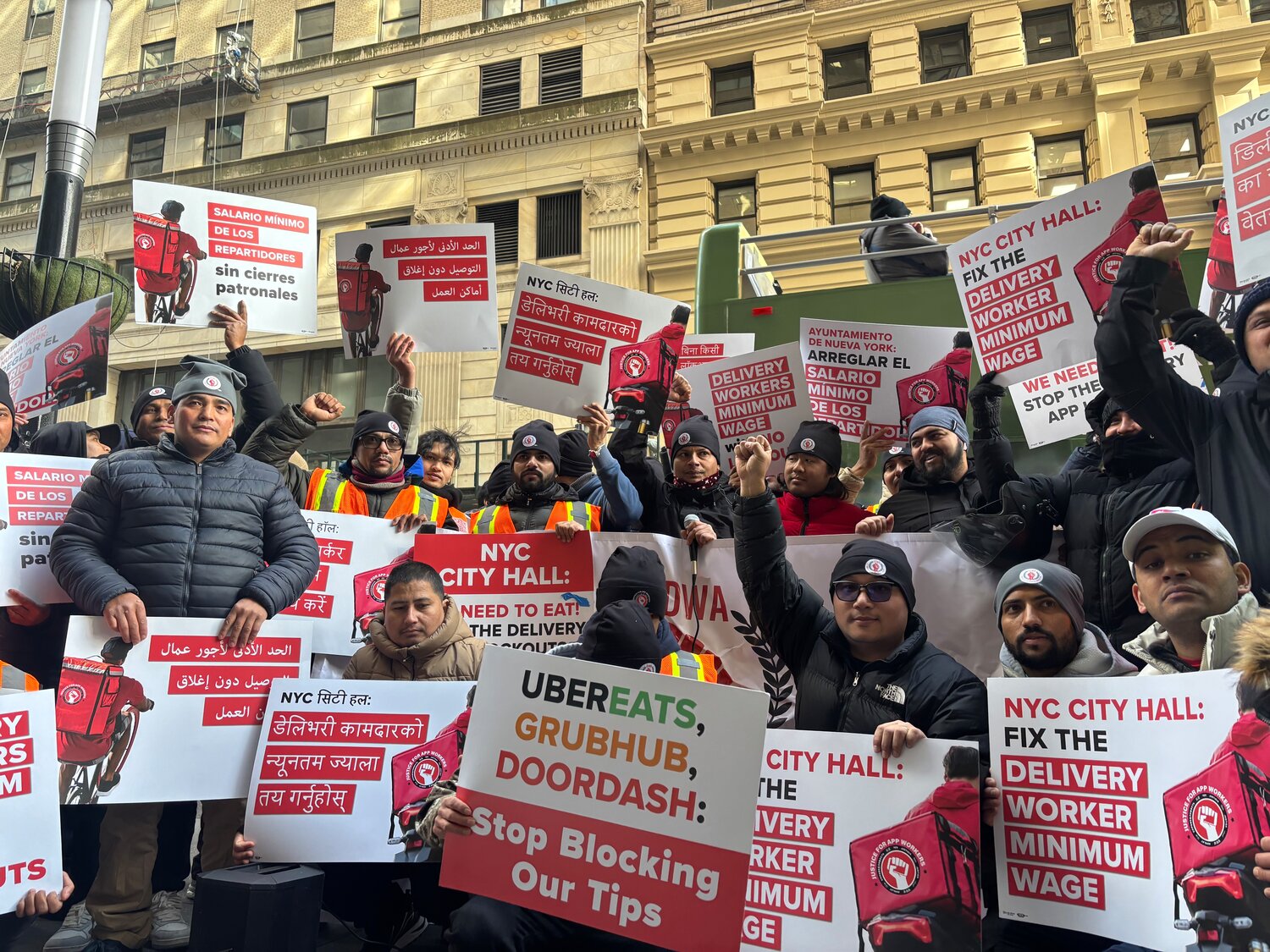
Under city legislation that took effect this week, food delivery apps can no longer bury the tipping option after checkout — a design trick that cost delivery workers in New York City more than $550 million in lost tips, according to the city's Department of Consumer and Worker Protection (DCWP).
The legislation, which took effect Monday, requires delivery apps to display tipping options to customers upfront rather than hiding them until after checkout, and to include a suggested tip of at least 10 percent. Platforms also must pay workers within seven days after the end of a pay period and give itemized written statements showing how their pay is calculated.
The laws' implementation came days after a significant legal victory for workers on Jan. 23 as courts rejected attempts by major app companies to block the legislation. Federal judges ruled against DoorDash and Uber in one case and Instacart in another, denying the companies’ requests to block the laws.
DoorDash and Uber collectively challenged the tipping transparency requirements, while Instacart fought against extending minimum pay to grocery delivery workers. Under city law, grocery apps like Instacart have to pay workers at least $21.44 an hour — which will increase to $22.13 an hour on April 1 — excluding tips with annual increases, matching the rate for food delivery workers.
'Huge victory'
William Medina, a part-time delivery worker and full-time organizer with advocacy group The Worker’s Justice Project, described the new tipping legislation as “a huge victory.”
“It makes me feel good because now I'm going to receive more money in my pocket and less money for multi-billion dollar corporations,” he told The Chief. “Right now we receive mostly nothing."
Medina, originally from Columbia, has been working for Uber Eats, DoorDash and Grubhub in the city for seven years. He explained that tips were more common during the COVID-19 pandemic but have decreased after the city passed a law raising the minimum wage for these workers in 2023.
At that time DoorDash and Uber Eats changed their apps so customers could only tip after checkout, instead of at the moment they placed an order.
According to the DCWP report released earlier this month, that change caused the average tip to drop from $3.66 to $0.93 in a single week, amounting to a $554 million loss in tips for workers and an estimated per-worker decrease of roughly $5,800. The current average tip now stands at just $0.76 per delivery.
By contrast, the report found that on restaurants’ own delivery platforms, where tipping options appear at checkout, the average tip is $2.17 per delivery, suggesting that New Yorkers are inclined to tip when given a clear and accessible option.

“Only with the minimum pay it’s not enough,” Medina told The Chief, noting that apps only pay drivers for “active time” — from accepting an order to dropping it off, not for the hours spent waiting for orders.
“If you’re out more than 12 hours a day and your active time is eight hours, the other 4 hours, you’re not going to receive anything,” he said. “Nothing."
Uber Eats and Instacart did not respond to a request for comment.
“Allowing this law to take effect means we will likely see an immediate drop off in orders for New York’s small businesses, a worse experience for customers, and fewer overall deliveries for New York City dashers," a spokesperson for DoorDash said in a statement. "Dashers in New York City earn roughly $30 an hour while on delivery before tips. Forcing platforms to solicit a tip before checkout at a time when New Yorkers are sick of tipping culture and facing a growing affordability crisis is bad policy–plain and simple.”
Workers, advocates celebrate
The Worker’s Justice Project and its subsidiary Los Deliveristas Unidos, which advocated for the legislation, released a statement calling the apps’ designs “deceptive” and the rulings a big win for worker organizing.
“These lawsuits are part of the corporate playbook designed to undermine the power of Los Deliveristas Unidos,” the statement said. “But the movement of 80,000 delivery workers has already won—and continues to win—setting new standards for minimum pay, tipping, and transparency.”
DCWP Commissioner Samuel Levine vowed to “vigorously enforce New York City's Delivery Worker Laws and hold Instacart and other companies that try to skirt the rules accountable,” in a Jan. 23 statement.
“Algorithms do not deliver groceries; people do,” he said.
The laws that took effect this week were sponsored by City Council Member Shaun Abreu, who said in a statement that he was "proud" to work with WJP and pass legislation that ends an "exploitative practice."
"After an unfounded last-ditch challenge by the apps, the law has officially taken effect, marking a significant victory for deliveristas citywide," he said. "We’ll continue to monitor its implementation and ensure compliance."
The rulings come amid broader efforts by the city; the advocacy groups’ statement referenced recent victories securing deactivation protections for delivery workers. Levine also announced a lawsuit against delivery app Motoclick earlier this month for allegedly stealing tips and failing to comply with minimum wage laws
DCWP also sent compliance warnings to over 60 companies including Instacart, DoorDash, Grubhub and Uber.
“The message is clear: The City of New York is with deliveristas, and together we are building a future where delivery work means fairness, respect, and dignity,” Levine said.


Comments
No comments on this item Please log in to comment by clicking here