


A few of our stories and columns are now in front of the paywall. We at The Chief remain committed to independent reporting on labor and civil service. It's been our mission since 1897. You can have a hand in ensuring that our reporting remains relevant in the decades to come. Consider supporting The Chief, which you can do for as little as $3.20 a month.
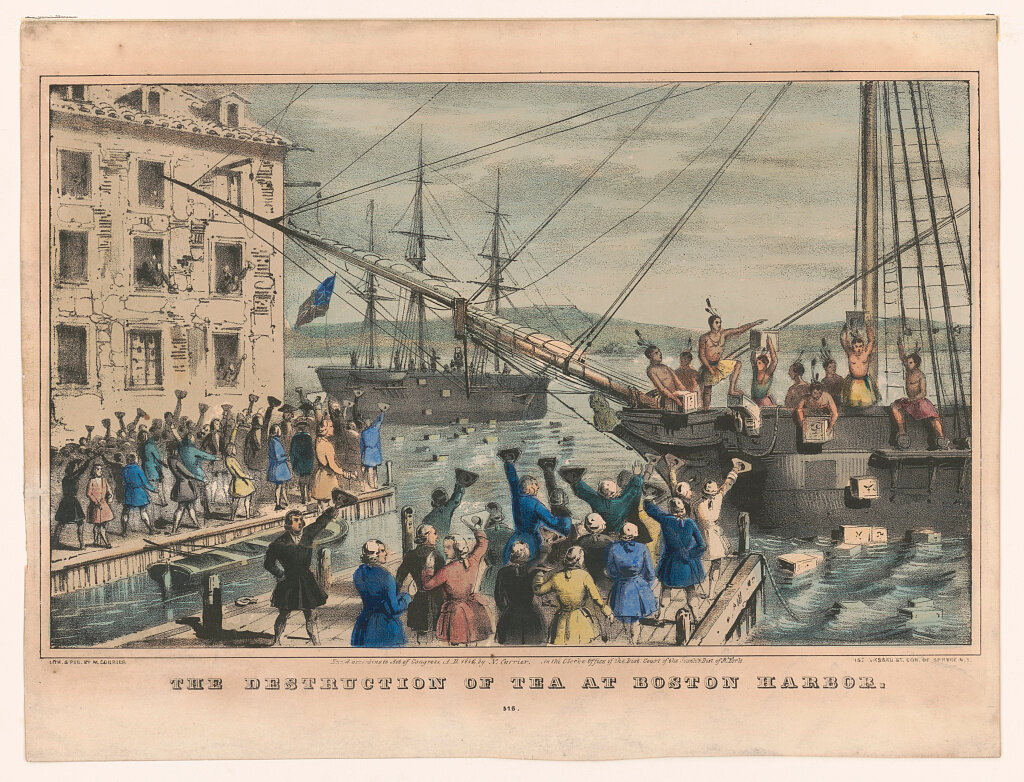
Every July 4, Americans celebrate the Declaration of Independence, the defeat of monarchy and the birth of a new republic. But one of the most immediate and material catalysts for American rebellion was resistance to the far-reaching corporate power of the British East India Company.
Long before Big Tech, Wall Street or multinational corporations, the American Revolution was sparked in part by resistance to the world's largest monopoly. In 1773, the company was struggling, so the British Parliament passed the Tea Act to eliminate market competition from American merchants—an early example of government using its powers to privilege corporations at the expense of the public.
The Boston Tea Party is remembered as a protest against taxation, but it was also a direct revolt against monopoly. The tea dumped into the harbor was East India Company property, and the rebels were challenging the state's enabling of corporate exploitation.
Among them were artisans, tradesmen, ropemakers, shipwrights and dock workers whose livelihoods depended on open, competitive trade. Skilled craftsmen in colonial cities had already begun forming mutual aid societies and trade associations to protect their economic standing against larger commercial interests.
After independence, that distrust of corporate power spread into debates over the nation’s founding. Thomas Jefferson pushed for the new Constitution to include explicit protections against monopolies, alongside guarantees of religious liberty and a free press.
He and many others believed political freedom required constraints on economic exploitation. The Constitution ultimately contained no such language, though many states later adopted their own provisions.
In the nineteenth century, general incorporation laws expanded business formation amidst the country’s industrialization, but they also enabled new concentrations of wealth. The Gilded Age saw railroad combines, oil trusts and industrial conglomerates accumulate power by eliminating competitors, fixing prices and influencing legislatures.
After the Civil War, farmers, industrial workers and small merchants built a growing national movement against such privilege. The Knights of Labor, founded in 1869, became one of the most ambitious labor organizations in American history.
Unlike craft unions organized by trade, the Knights sought to unite all workers—Black and white, skilled and unskilled, men and women—into a single democratic institution capable of challenging concentrated capital. At its peak in 1886, the organization claimed more than 700,000 members. Together with the Farmers Alliance and the People's Party, their campaigns helped produce the Interstate Commerce Act of 1887 and the Sherman Antitrust Act of 1890.
Courts nonetheless issued sweeping injunctions against union activity, and labor leaders including Eugene Debs were jailed. The legal and military apparatus of the state had aligned with consolidated capital. The Industrial Workers of the World sought to organize entire industries rather than individual trades. Garment workers in New York built unions in the aftermath of the 1911 Triangle Shirtwaist Factory fire, which killed 146 workers after it exposed the lethal consequences of unregulated industrial power.
Franklin D. Roosevelt was one of the few Presidents to treat corporate power explicitly as a threat to democracy. The National Labor Relations Act of 1935 guaranteed workers the legal right to organize and bargain collectively for the first time.
Senator Robert Wagner argued that without unions, individual workers had no meaningful capacity to negotiate with employers operating at national scale. Union membership climbed to roughly 35 percent of the workforce by the late 1940s.
By the 1970s, that consensus had eroded. Policymakers increasingly accepted the view that corporate consolidation was acceptable so long as consumer prices stayed low. Merger enforcement weakened, industries consolidated and union density fell in tandem.
By the early twenty first century, sectors from agriculture and healthcare to telecommunications and technology had grown more concentrated than at any point in decades. A company like Google now dominates internet search, digital advertising, cloud infrastructure and video distribution—accumulating economic and political influence that rivals the inequality that the Gilded Age produced.
A handful of companies are racing to control artificial intelligence infrastructure, data and deployment—a consolidation that threatens to automate millions of jobs while concentrating the resulting economic gains in fewer hands than ever before.
New organizing drives have emerged in response. Workers at Amazon warehouses, Starbucks locations and Apple retail stores have increased their organizing efforts. Federal antitrust enforcement grew more aggressive in the early 2020s, with regulators challenging mergers in technology, publishing and healthcare. And almost every new fight for a contract includes language about protecting workers from the threat of AI.
In cities such as New York, civil workers like teachers, transit workers and uniformed officers have fought to preserve collective bargaining rights and continue to galvanize a new wave of solidarity.
This July 4, as Americans mark another Independence Day with fireworks and parades, many workers will remember that the holiday commemorates not just a political revolution, but an economic one.
The men who boarded those ships in Boston Harbor were tradesmen and laborers pushing back against a system that concentrated power in the hands of the few. That fight—waged since on picket lines, in courtrooms and on the floors of Congress—is as old as the United States, and by most measures, has never finished.
-Carter Myers-Brown


Comments
No comments on this item Please log in to comment by clicking here